Two new reconstruction technologies recently introduced by ZEISS use Artificial Intelligence (AI) to improve data collection and analysis, and speed up decision-making significantly. Now available for the Advanced Reconstruction Toolkit (ART) on ZEISS Xradia 3D X-ray platforms, ZEISS DeepRecon Pro and ZEISS PhaseEvolve modules increase throughput by up to 10x while producing better than ever image quality. They’re designed for research fields including geosciences, pharmaceuticals, electronics, battery and engineering materials as well as for semiconductor failure analysis.
ZEISS ART gives researchers continuous access to the latest technologies for reconstruction, providing flexible workflow strategies as their imaging needs evolve. The toolbox is based on advancing reconstruction technologies beyond the typical “filtered back projection” or Feldkamp-Davis-Kress (FDK) algorithms. It enables acquisition and analysis with even fewer projections, reducing scan times by up to 10x, depending on the sample type and size, thus saving a considerable amount of time. These developments offer real benefits to professionals in academic R&D, high technology industry R&D, and industrial quality control & failure analysis laboratories as well as to university shared (core) facilities and mining/oil exploration (economic GEO) test labs.
ZEISS DeepRecon Pro
ZEISS offers DeepRecon AI-based technology in two forms: ZEISS DeepRecon Pro and ZEISS DeepRecon Custom. Both modules provide improved image quality at high speed. DeepRecon Pro is a reconstruction technology that provides up to 10x higher throughput along with image quality benefits across a diverse set of sample types. It is applicable to unique samples as well as to semi-repetitive and repetitive workflows. Users can now train new machine learning network models themselves, working on-site with an easy-to-use interface.
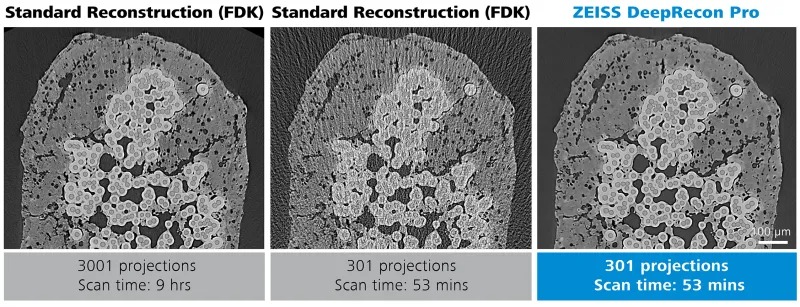
ZEISS DeepRecon Custom is targeted specifically at repetitive workflow applications. ZEISS collaborates closely with users to develop custom-created network models that fit their repetitive application needs precisely.
ZEISS PhaseEvolve
ZEISS PhaseEvolve is a post-processing reconstruction algorithm that enhances the image contrast by revealing the material contrast uniquely inherent to X-ray microscopy, often overprinted by phase effects in low-medium density samples or in high-resolution imaging. This new module allows users to conduct more accurate quantitative analyses with improved contrast and segmentation of results.
Dr. Markus Ohl, Department of Earth Sciences, Utrecht University (The Netherlands) was one of the first users of ART. He says: “
ZEISS DeepRecon Pro provides a straightforward, uncomplicated and powerful application of AI and deep neural network technology for enhancing X-ray tomography results without prior knowledge on deep learning technology.”
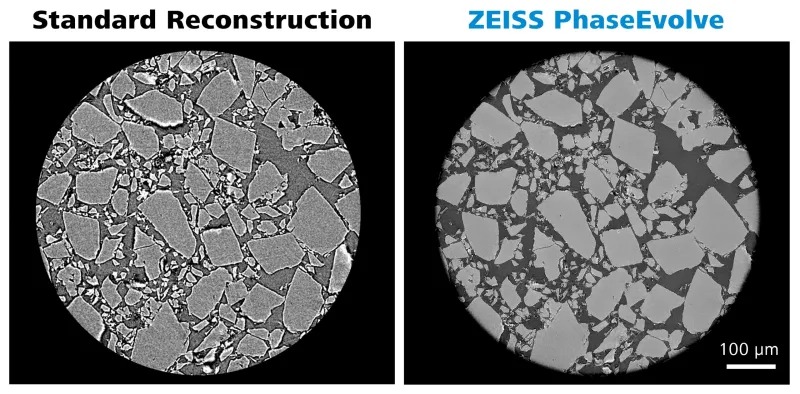
Both ZEISS DeepRecon Pro and ZEISS PhaseEvolve modules offer greatly improved image quality for many applications – typically 3D non-destructive sub-µm resolution imaging and 4D in situ studies. The traditional challenge of choosing between either image quality or sample throughput has been resolved with these new capabilities.
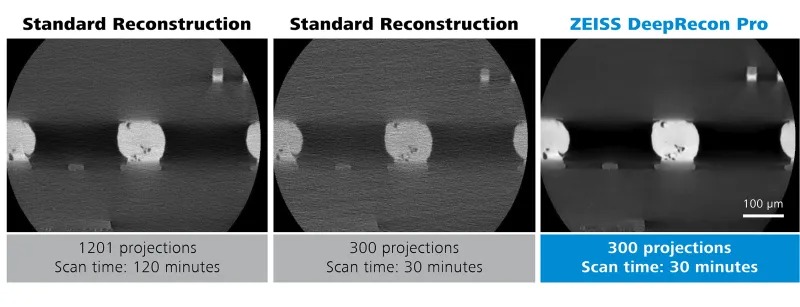
ZEISS ART with the optional DeepRecon and PhaseEvolve modules is available for upgrade on existing ZEISS Xradia Versa and Context microscopes, enhancing the capability of installed systems as well as on new ZEISS Xradia X-ray microscopes.
For more information:
www.zeiss.com

 Tiếng Việt
 Tiếng Anh
 Tiếng Hàn
 Tiếng Trung