 Tiếng Việt
 Tiếng Anh
 Tiếng Hàn
 Tiếng Trung
Aircraft maintenance, repair and overhaul (MRO) operations ensure that aircraft are always safe to fly during their whole service life. An integral part of any aircraft maintenance scheme is the engine repair and overhaul.
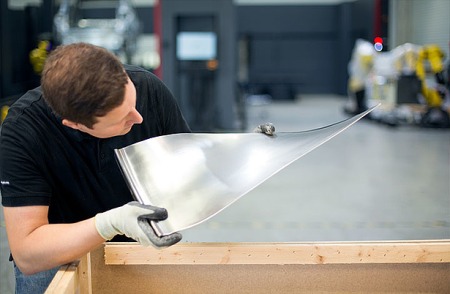 Especially, fan blades of modern aircraft propulsion turbines have to withstand extreme operating conditions during their service life. To guarantee the highest possible level of safety, fan blades are continuously checked for their integrity. Furthermore, fan blades are exposed to lightning, ice and bird strikes. Incidents like these trigger the so-called long service inspection during which defective fan blades need to be identified and replaced. This procedure is costly and time-consuming as it includes the complete disassembly of the turbine. During the time of the service inspection, an expensive exchange turbine will keep the aircraft up and running. Obviously, airlines want to reduce the downtime of their jet engines to a minimum.
A fast inspection of each fan blade without the need to disassemble the whole turbine would save a lot of time and money. Imagine the service technician could carry out a measurement on each fan blade with a quick response on the state of the component – safe to fly or not?
GOM’s 3D testing sensor ARAMIS enters the stage. Using the point tracking technology of ARAMIS, the fan blade’s reaction to hammer impact tests can be evaluated and used for the calculation of the ODS (Operating Deflection Shapes) of the individual fan blade. The comparison of the actual measured operating 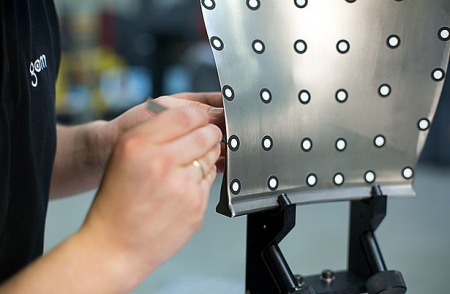 deflection shapes to the simulated mode shapes or the actual state from past measurements of the fan blade allows drawing conclusions on the integrity of the component. If there is a shift between measured and simulated mode shape or a complete change in the characteristic resonances (for example, over life), then there could be a crack somewhere in the blade and it needs to be replaced.
GOM has carried out a study on a single fan blade to prove the general feasibility of the concept.
Preparation of Measuring Object
ARAMIS uses ultra lightweight adhesive reference point markers for measuring and tracking 3D coordinates in space. Due to the non-contact principle of the measuring system, there is no wiring of sensors needed at all opposed to traditional accelerometers. Each reference point marker provides information on displacements in all three spatial directions plus measuring data on speeds and accelerations. Typically, hundreds of reference point markers can be applied to the testing object due to the fast and easy application of the stickers and their light weight. This results in a high density of data for the subsequent vibration analysis.
 Measurement of Hammer Impact Test
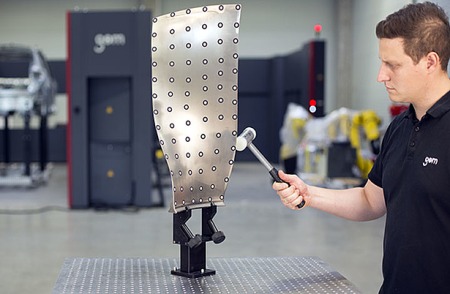
The hammer impact test is widely used in vibration analysis. The hammer impact event excites the fan blade with a transient vibration and allows the identification of its resonant frequencies. It was known from numerical simulations that the fan blade was supposed to show the most important resonances in the range of frequencies up to 1500 Hz. Therefore, the ARAMIS system measured with a ten times higher sampling frequency of 15,000 frames per second.
Vibration Analysis
The optical measuring system ARAMIS provides accurate data on 3D displacements. The integrated analysis tool uses this data for calculating the frequency response function that allows the identification of resonant frequencies of the fan blade. Moreover, ARAMIS calculates the operating deflection shapes of the fan blade for each frequency that is contained in the excitation spectrum. This allows extracting amplitude values for hundreds of measuring points that are simultaneously captured during the measurement of the vibration fading away.
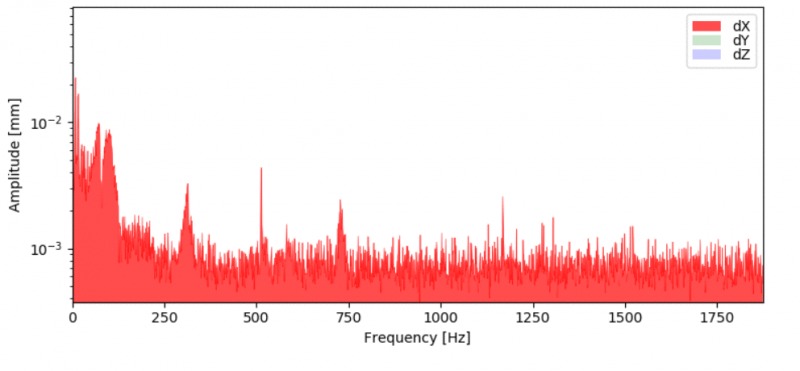
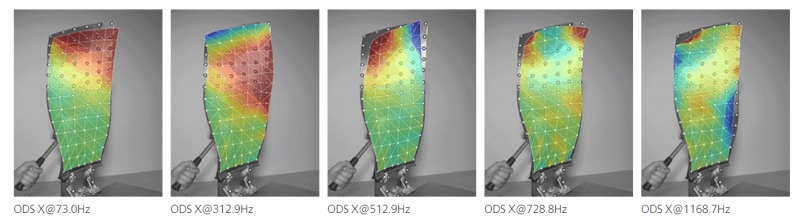
Comparison to Numerical Simulation of Mode Shapes – Decision: Safe to Fly?
Once the ODS (Operating Deflection Shapes) are determined in the ARAMIS Professional software, they enable the comparison to the simulated mode shapes. In case that there are significant differences in the characteristic resonant frequencies between mode shapes and the measured ODS this indicates that the fan blade is defective and needs to be replaced.
For more information: www.gom.com