Optimizing Manufacturing Performance through 5G, Edge Computing and Machine Vision
GSMA, China Mobile, Huawei and Haier have completed a proof of concept encompassing the deployment of edge computing, 5G and machine vision into Haier’s manufacturing environment. Haier is the world’s largest white goods manufacturer and a Fortune 500 company.
Machine Vision is an intensive computing task that needs dedicated resources and complex application support to achieve meaningful data from the analysis of a still or moving image. In a fast paced commercial environment, there is an almost constant flow of images that are required to be analysed in order to implement corrective actions. This means that data processing capabilities needs to be placed close to the recording camera in order to minimise latency and achieve near real-time results.
Production quality is of utmost importance to Haier. Stainless steel refrigerators are at the top of their range, but due to the nature of stainless steel, can suffer imperfections through scratching and denting during the course of the production process. Therefore, Haier manually check every refrigerator that comes from the production line for defects in the stainless steel, which can be a time-consuming task.
Using Machine Vision to accomplish this task means that a more thorough quality assurance process can be undertaken, with less risk of defects being missed by manual checking. The use of edge computing and 5G means that near-real time analysis takes place so refrigerators can be returned to the production line almost instantly.
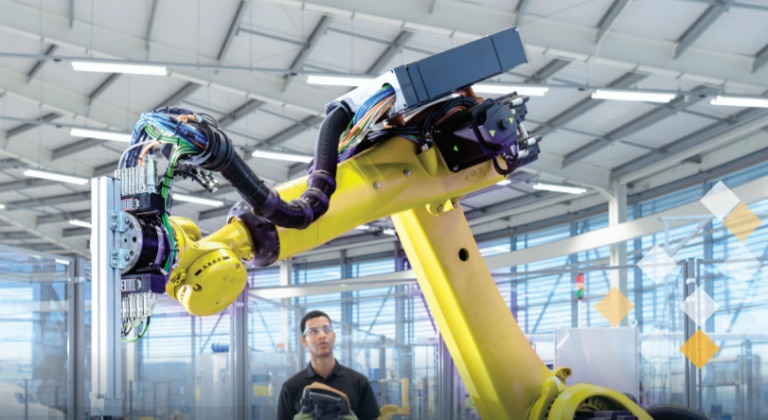
Huawei and China Mobile implemented a 5G connected MEC (Mobile Edge Computing Platform) architecture inside the Haier factory to enable high-volume image processing with minimal latency to ensure no delays to the production line. The edge server is used to host the machine vision application from Mstar and all data processing is conducted within the production facility. The Huawei MEC Platform (MEP) works to dynamically allocate and adjust available resources so that the machine vision application is able to operate at maximum efficiency the whole time and the data processing workload on the server can be efficiently managed. Additionally, MEP sends data analytics reports to end users so that appropriate tracking can occur.
5G enables efficient MEC deployments as the user plane and control plane functions (UPF) can be separated. In this user case, it means that 5G network functions could be moved closer to the production line, resulting in much reduced latency and improved reliability of data packet delivery. The MEC infrastructure includes both UPF and MEP (Multi-access Edge Platform) deployed on one server, meaning the deployment is further simplified and space requirements for hosting are greatly reduced.
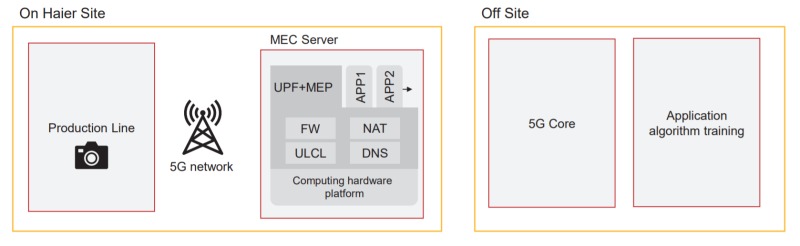
Before the live production environment could be initiated, the machine vision algorithm first needed to be trained. By collecting sample images, the machine vision application could be ‘trained’ to identify anomalies in images from the real-time production environment. Once trained, the adapted algorithm could be uploaded into the MEC architecture. As more images are processed by the application, the accuracy of the algorithm hunting for anomalies improves.
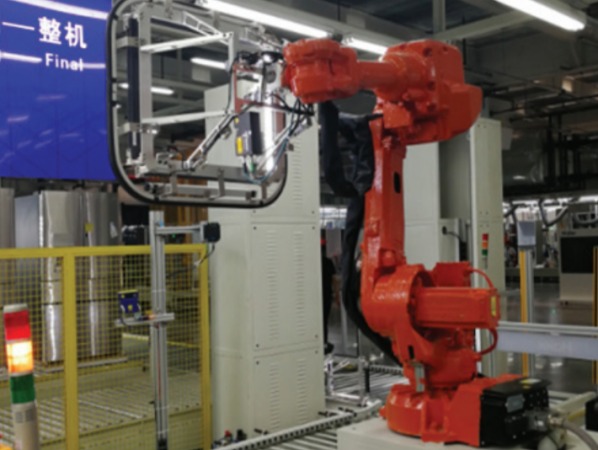
Haier’s Robotic ArmThe Haier factory has mounted a 500W industrial camera onto a robotic arm, with high intensity lighting, which is able to scan the refrigerators as they come off the production line. By using the trained algorithm, the local application is able to identify any damage to the refrigerators exterior that requires replacement. Small scratches and dents which may be missed by the human eye can be easily identified.
The Key Role of 5G
The 5G network is required to transfer the large images produced by the industrial camera whilst maintaining low latency. The network requirements are in the order of 42Mbit/s upstream with image analysis completed in around 200-300ms. This means that a 5G network is the only realistic network that can handle this volume of data whilst maintaining low latency and the ability to operate within a small footprint inside the factory production line.
Outcome
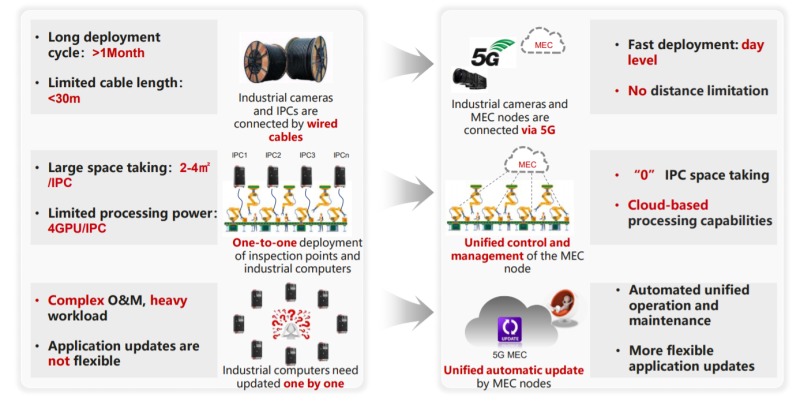
A number of benefits have been recorded through the duration of the proof of concept. Improved implementation times. The 5G MEC infrastructure was installed and implemented in the Haier plant in only 1.5 days, compared to up to 35 days for legacy systems. This is due in part to extensive algorithm training conducted off site. Additionally, the MEC infrastructure includes an integrated HPF and MEP design, which makes the configuration and setup extremely simple. This meant a time saving of over 100 man-days which would otherwise have been spent setting up and testing the 5G MEC machine vision system on site.
Reduced space and resources required, compared to legacy solutions. The 5G MEC infrastructure is able to operate in a confined space close to the production line, due to the integration of UPF and MEP in a single server, and localised telecommunications equipment. This means that the infrastructure can be installed in a variety of configurations for a variety of use cases whilst maintaining close proximity to the industrial equipment to be monitored, ensuring low latency.
Improved product quality monitoring. The machine vision infrastructure has improved the overall product quality of refrigerators on the production line, as more defects can be accurately detected. This in turn results in fewer product returns and increased customer satisfaction.
Advantages of 5G MEC + Machine Vision solution over conventional Machine Vision
Haier Home Appliance is the world’s No.1 home appliance brand, with a 10.5% global market share. Its brands include Haier, Casarte, and Leader in China, GE Appliances in the US, Fisher & Paykel in New Zealand, and AQUA in Japan.

 Tiếng Việt
 Tiếng Anh
 Tiếng Hàn
 Tiếng Trung
 Huawei and China Mobile implemented a 5G connected MEC (Mobile Edge Computing Platform) architecture inside the Haier factory to enable high-volume image processing with minimal latency to ensure no delays to the production line. The edge server is used to host the machine vision application from Mstar and all data processing is conducted within the production facility. The Huawei MEC Platform (MEP) works to dynamically allocate and adjust available resources so that the machine vision application is able to operate at maximum efficiency the whole time and the data processing workload on the server can be efficiently managed. Additionally, MEP sends data analytics reports to end users so that appropriate tracking can occur.
5G enables efficient MEC deployments as the user plane and control plane functions (UPF) can be separated. In this user case, it means that 5G network functions could be moved closer to the production line, resulting in much reduced latency and improved reliability of data packet delivery. The MEC infrastructure includes both UPF and MEP (Multi-access Edge Platform) deployed on one server, meaning the deployment is further simplified and space requirements for hosting are greatly reduced.
Huawei and China Mobile implemented a 5G connected MEC (Mobile Edge Computing Platform) architecture inside the Haier factory to enable high-volume image processing with minimal latency to ensure no delays to the production line. The edge server is used to host the machine vision application from Mstar and all data processing is conducted within the production facility. The Huawei MEC Platform (MEP) works to dynamically allocate and adjust available resources so that the machine vision application is able to operate at maximum efficiency the whole time and the data processing workload on the server can be efficiently managed. Additionally, MEP sends data analytics reports to end users so that appropriate tracking can occur.
5G enables efficient MEC deployments as the user plane and control plane functions (UPF) can be separated. In this user case, it means that 5G network functions could be moved closer to the production line, resulting in much reduced latency and improved reliability of data packet delivery. The MEC infrastructure includes both UPF and MEP (Multi-access Edge Platform) deployed on one server, meaning the deployment is further simplified and space requirements for hosting are greatly reduced.
 Before the live production environment could be initiated, the machine vision algorithm first needed to be trained. By collecting sample images, the machine vision application could be ‘trained’ to identify anomalies in images from the real-time production environment. Once trained, the adapted algorithm could be uploaded into the MEC architecture. As more images are processed by the application, the accuracy of the algorithm hunting for anomalies improves.
Haier’s Robotic Arm
Before the live production environment could be initiated, the machine vision algorithm first needed to be trained. By collecting sample images, the machine vision application could be ‘trained’ to identify anomalies in images from the real-time production environment. Once trained, the adapted algorithm could be uploaded into the MEC architecture. As more images are processed by the application, the accuracy of the algorithm hunting for anomalies improves.
Haier’s Robotic Arm
 The Haier factory has mounted a 500W industrial camera onto a robotic arm, with high intensity lighting, which is able to scan the refrigerators as they come off the production line. By using the trained algorithm, the local application is able to identify any damage to the refrigerators exterior that requires replacement. Small scratches and dents which may be missed by the human eye can be easily identified.
The Key Role of 5G
The 5G network is required to transfer the large images produced by the industrial camera whilst maintaining low latency. The network requirements are in the order of 42Mbit/s upstream with image analysis completed in around 200-300ms. This means that a 5G network is the only realistic network that can handle this volume of data whilst maintaining low latency and the ability to operate within a small footprint inside the factory production line.
Outcome
A number of benefits have been recorded through the duration of the proof of concept. Improved implementation times. The 5G MEC infrastructure was installed and implemented in the Haier plant in only 1.5 days, compared to up to 35 days for legacy systems. This is due in part to extensive algorithm training conducted off site. Additionally, the MEC infrastructure includes an integrated HPF and MEP design, which makes the configuration and setup extremely simple. This meant a time saving of over 100 man-days which would otherwise have been spent setting up and testing the 5G MEC machine vision system on site.
Reduced space and resources required, compared to legacy solutions. The 5G MEC infrastructure is able to operate in a confined space close to the production line, due to the integration of UPF and MEP in a single server, and localised telecommunications equipment. This means that the infrastructure can be installed in a variety of configurations for a variety of use cases whilst maintaining close proximity to the industrial equipment to be monitored, ensuring low latency.
Improved product quality monitoring. The machine vision infrastructure has improved the overall product quality of refrigerators on the production line, as more defects can be accurately detected. This in turn results in fewer product returns and increased customer satisfaction.
The Haier factory has mounted a 500W industrial camera onto a robotic arm, with high intensity lighting, which is able to scan the refrigerators as they come off the production line. By using the trained algorithm, the local application is able to identify any damage to the refrigerators exterior that requires replacement. Small scratches and dents which may be missed by the human eye can be easily identified.
The Key Role of 5G
The 5G network is required to transfer the large images produced by the industrial camera whilst maintaining low latency. The network requirements are in the order of 42Mbit/s upstream with image analysis completed in around 200-300ms. This means that a 5G network is the only realistic network that can handle this volume of data whilst maintaining low latency and the ability to operate within a small footprint inside the factory production line.
Outcome
A number of benefits have been recorded through the duration of the proof of concept. Improved implementation times. The 5G MEC infrastructure was installed and implemented in the Haier plant in only 1.5 days, compared to up to 35 days for legacy systems. This is due in part to extensive algorithm training conducted off site. Additionally, the MEC infrastructure includes an integrated HPF and MEP design, which makes the configuration and setup extremely simple. This meant a time saving of over 100 man-days which would otherwise have been spent setting up and testing the 5G MEC machine vision system on site.
Reduced space and resources required, compared to legacy solutions. The 5G MEC infrastructure is able to operate in a confined space close to the production line, due to the integration of UPF and MEP in a single server, and localised telecommunications equipment. This means that the infrastructure can be installed in a variety of configurations for a variety of use cases whilst maintaining close proximity to the industrial equipment to be monitored, ensuring low latency.
Improved product quality monitoring. The machine vision infrastructure has improved the overall product quality of refrigerators on the production line, as more defects can be accurately detected. This in turn results in fewer product returns and increased customer satisfaction.