- Giỏ hàng chưa có sản phẩm
Joel Berkson, a third-year doctoral student in the University of Arizona James C. Wyant College of Optical Sciences and Steward Observatory, has developed a new way for precisely measuring the surfaces of radio antenna, which are used to collect and focus radio waves for astronomy and satellite communications.
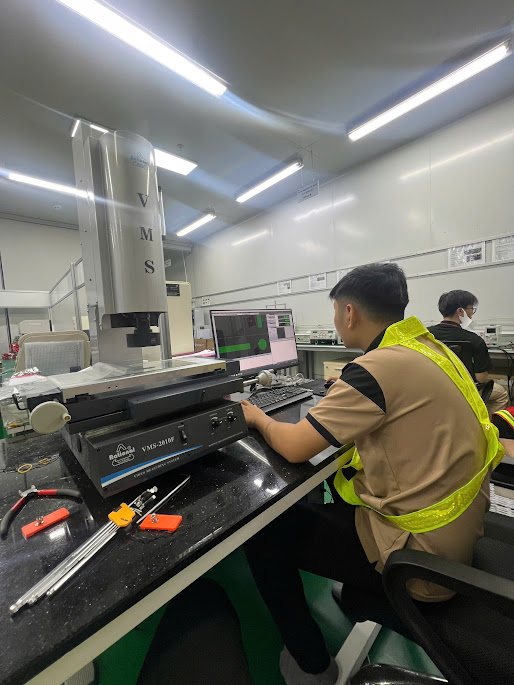
These dish-shaped antennas must be manufactured with an extremely high level of accuracy to work well. To ensure their accuracy, engineers measure the antenna surfaces using metrology, a technique that applies the science of measurement to manufacturing, instrumentation and calibration processes.
“People always want to make larger, more accurate antennas for radio telecscopes, and more of them,” Berkson said. “If we can’t figure out better ways to make them faster and more accurate, the cost and time it takes to measure each surface to ensure its quality will be prohibitive.”
Existing methods for measuring curved surfaces of radio antennas and telescope mirrors involve placing stickers across the antenna or mirror surface and then using cameras to analyze the surface by looking at the stickers. Other methods involve physically probing the surface with a coordinate measuring machine. These techniques are limited to only measuring the number of points indicated by the stickers or touched by a physical probe; it is a manual, slow and often expensive process.
To make things even more complicated, sometimes the surfaces do not come out perfectly and need to be fixed and measured again, translating into more money and time spent.
Berkson’s invention eliminates the need for stickers or physical touch. The method he developed uses a combination of laser projectors and cameras to create a 3D model of the surface. By rendering the actual surface shape as a computer model, the new process overcomes another limitation of the old methods; rather than being limited to measuring hundreds of points, it allows for the measurement of millions of points on a surface.
Tech Launch Arizona, the UArizona office that commercializes inventions stemming from university research, has worked with Berkson to patent the technology on behalf of the university and license it to Berkson’s startup, Fringe Metrology. “It was particularly rewarding to see Joel’s work, envisioning an approach to address a real-world challenge and transforming it into an elegant commercial solution,” said Bruce Burgess, director of venture development at TLA. “Joel recognized the wealth of resources TLA offers researchers and was quick to work with our team.” “A lot of systems out there today are black-box systems and need customization to be useful in the field,” Berkson said. “Ours is one system that can be easily configured to measure surfaces of different shapes and sizes. You can’t do that with any other current technologies out there.” When Berkson realized existing metrology systems require the use of stickers to make measurements, he was inspired to take a problem-solving approach to simplifying the process. “Stickers have been used across the board and are the standard and well-trusted,” he said, “but as the demand for more accurate and complicated surfaces increases, the measurement requirements equally increase. The current methods are not as good as people want and need to be able to advance these systems.” Working with his co-inventor, Justin Hyatt, a senior research associate at Steward Observatory, Berskon began developing the invention with funding from the National Science Foundation to advance current methods for radio telescope manufacturing. He connected with the TLA commercialization team, which worked with him to develop the intellectual property for the invention. Berkson then started Fringe Metrology, licensed the invention from UArizona and has begun building a business around it. The startup is developing specialized systems for a variety of surface metrology applications but initially will focus on the meticulous measurements needed for the manufacture of radio telescope panels. “The radio telescopes like the ones you see in the movie ‘Contact’ are very precise and expensive to manufacture, and they need to be perfectly shaped to function correctly,” Berkson said. “The company will initially focus on these high-value customers to develop the initial go-to-market product.” As Berkson focuses on growing his business, he hopes the technology can offer a solution for the current limitations in radio telescope manufacturing and contribute to the evolution of the industry. “Ultimately,” he said, “I’d like to see quicker, cheaper, higher quality measuring systems in every lab.” Fore more information: www.arizona.eduBài viết liên quan
Tin mới nhất
 Tiếng Việt
 Tiếng Anh
 Tiếng Hàn
 Tiếng Trung