New Models of Field Emission Scanning Electron Microscopes Introduced
ZEISS presents a new generation of its field emission scanning electron microscope (FESEM) family ZEISS GeminiSEM. The new models ZEISS GeminiSEM 360, 460 and 560 are tailored for sub-nanometer imaging and effortless analytics. Users benefit from innovations in the electron optics and a new chamber design offering better image quality, usability and flexibility. ZEISS GeminiSEM 560 now being introduced brings the ZEISS Gemini 3 column to the market for the first time.
The new ZEISS GeminiSEM family delivers more information from any sample, minimizes sample damage and prevents sample artifacts. All three models come with a completely new chamber design which allows researchers to bring in larger and more samples than before enabling core facilities to now serve many more analytical applications in a single instrument. The unique designs for the ZEISS Gemini electron optical column and a large, flexible new chamber cover all imaging and analytical needs. The larger chamber enables configurability and flexibility to adapt to upcoming research tasks and optimizes analytical workflows.
New Electron Optical Column and Smart Autopilot
ZEISS GeminiSEM 560 sets a new standard for surface imaging. Introducing the new ZEISS Gemini 3 electron optics with Nano-twin lens and its new electron optical engine Smart Autopilot, it is customized for ease-of-use when imaging the most sensitive samples at the highest resolutions. In the ZEISS GeminiSEM family, the model 560 delivers the highest resolution at all working conditions and pushes the limits of immersion and monochromation-free-surface imaging at landing energies below 1 kV.
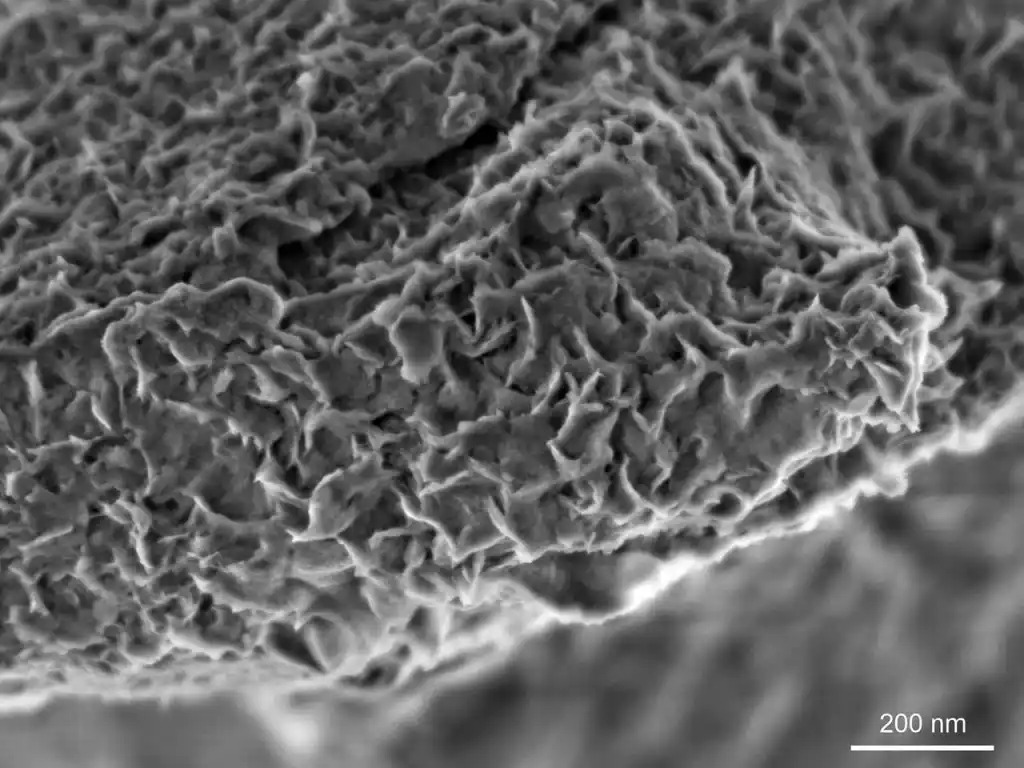
Nanometer-scaled features on the fractured surface of a non-conductive mineral, montmorillonite, visualized at low landing energy, ZEISS GeminiSEM 560, Inlens SE image, 800 V, scale bar 100 nm.
The new optical engine combined with new autofunctions and the patented autofocus significantly enhance the performance and efficiency of the system. In a core facility even novice users can achieve the best possible results without the support of the chief technician or facility manager.
More Efficiency and Ease-of-Use in Imaging and Analytics
The system enables the effortless transition from standard settings to advanced settings. A new overview mode simplifies orientation on the sample. Users can easily navigate from low to high magnification without having to adjust the column alignment. The system enables the largest distortion-free field of view in its class. This allows imaging of large, challenging samples such as magnetic specimens in materials research. The improved autofunctions are currently the fastest in the world with the autofocus delivering a focused image in less than one second.
“This product launch redefines high end FESEM imaging, advancing the evolution of the industry leading Gemini optics and puts the capability in the customers’ hands to enable scientific breakthroughs”, comments Dr. Michael Albiez, Head of ZEISS Research Microscopy Solutions.
For more information: www.zeiss.com/microscopy/

 Tiếng Việt
 Tiếng Anh
 Tiếng Hàn
 Tiếng Trung