Mobile MEMS-Based 3D Depth Camera Technology Unveiled
At the recent CES 2022 Expo, German deep tech company for MEMS-based AR/VR display and 3D sensing solutions, unveiled its mobile 3D LiDAR camera technology. OQmented’s ultra-compact 3D depth sensing camera provides a cost-effective solution for upgrading mobile or stationary cameras with complimentary RGB-D technology. Applying a biaxial MEMS laser scanner, it is designed around a patented structured light projector and delivers accurate high-resolution scans across an adjustable large field of view.
Unlike conventional low-resolution infrared dot projectors, OQmented’s LiDAR camera projects dynamically changing infrared patterns by applying the patented Lissajous laser scanning technology which is key to frame rates in the kilohertz range. Concentrating all laser energy of an eye-safe IR laser in a single spot that is dynamically scanned by the biaxial MEMS mirror is crucial for overcoming the typical depth range and resolution limitations of standard 3D LiDAR cameras with stationary IR dot projectors.
The unique dynamic infrared pattern projector in OQmented’s 3D depth camera technology can convert smartphones with regular RGB cameras into smartphones with 3D LiDAR cameras. Minimized hardware and artificial Intelligence algorithms for depth reconstruction enable maximum cost efficiency and compactness of the device. In addition to 3D depth camera applications for smartphones, OQmented’s LiDAR cameras can be specifically trained and adapted for other use cases, such as gesture recognition, AR/MR/VR context or people counting.
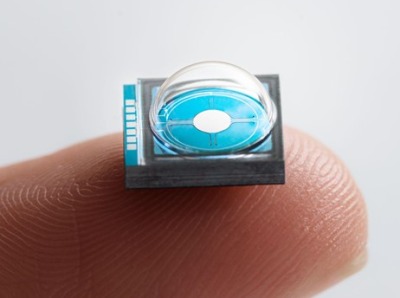
OQmented’s laser beam scanning solution with Bubble MEMS technology
The applications for 3D camera technology are manifold, both for consumer and commercial fields. Global Industry Analysts forecast the 3D camera market to reach a global market size of $13.4 billion by 2026. OQmented’s technology addresses the challenge of achieving high resolution images with just a few components, a small form factor, cost-efficiency and very low power consumption.
“Achieving the minimum device size but also the necessary high performance is a challenge for which we have developed a very cost-effective solution,” said Ulrich Hofmann, CEO/CTO and co-founder of OQmented. Thomas von Wantoch, CEO/CFO and co-founder of OQmented, adds, “Fast, compact and accurate 3D scanning systems will play an important role for all AR/MR/VR applications”
OQmented also showcased at CES 2022 an innovative AR smart glasses technology demonstration that incorporates and applies OQmented’s Bubble MEMS technology. Bringing together OQmented’s one-chip MEMS projection solution and the diffractive waveguide display of their partner Dispelix, the smart glasses demo leveraged laser beam scanning technology to enable stylish and lightweight Augmented Reality glasses.
In November OQmented announced that it extended its seed round and secured an additional USD 9.3 million. The deep tech startup has raised nearly US$20 million since its 2018 spin-out from the Fraunhofer Institute in Germany. In a statement the company said “the new funding will fast-track market penetration of OQmented’s MEMS mirror-based laser beam scanning (LBS) technology for AR/VR smart glasses. The tiny projection display, the industry’s first one-chip solution, gives product innovators the essential enabling technology for smart glasses that offer powerful visualization capabilities in a stylish, virtually weightless frame. The product will help propel AR/VR technologies into the mainstream, smoothing the runway to the next iteration of the internet, and enabling applications like 3D cameras, LiDAR, and machine vision products.”
For more information: www.oqmented.com

 Tiếng Việt
 Tiếng Anh
 Tiếng Hàn
 Tiếng Trung