- Giỏ hàng chưa có sản phẩm
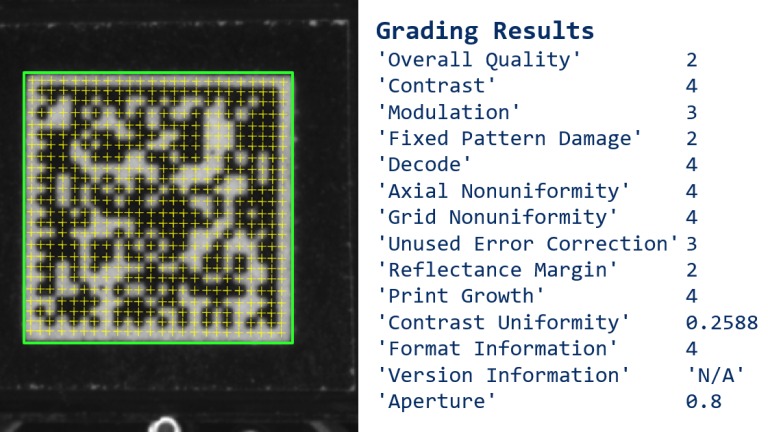 Print Quality Inspection (PQI) refers to the evaluation and grading of certain aspects of printed bar and data codes according to international standards. For example, it indicates how reliable a code can be read by various code readers or how stable the print quality is in a manufacturing process. HALCON supports various standards for grading the print quality of 1D and 2D codes. With HALCON 22.05, the PQI of data codes has been further improved. It is now up to 150% faster. In addition, the module grid determination for print quality inspection of ECC 200 has been improved. Last but not least, the usability of the PQI of data codes has been improved by introducing a new procedure that provides the grades.
With HALCON 22.05, various improvements are released. One example is a new operator that performs adaptive histogram equalization to improve contrast locally in an image. This helps to extract significantly more information from images with low contrast, especially in case of inhomogeneous gray value gradient. Besides, the HALCON library has been extended with a new operator which allows image smoothing with arbitrarily shaped regions. Furthermore, another new operator allows users to transform 3D points using a rigid 3D transformation that is specified as a dual quaternion. HDevelop’s Matching Assistant also now generates the code based on Generic Shape Matching.
For more information: www.mvtec.com
Print Quality Inspection (PQI) refers to the evaluation and grading of certain aspects of printed bar and data codes according to international standards. For example, it indicates how reliable a code can be read by various code readers or how stable the print quality is in a manufacturing process. HALCON supports various standards for grading the print quality of 1D and 2D codes. With HALCON 22.05, the PQI of data codes has been further improved. It is now up to 150% faster. In addition, the module grid determination for print quality inspection of ECC 200 has been improved. Last but not least, the usability of the PQI of data codes has been improved by introducing a new procedure that provides the grades.
With HALCON 22.05, various improvements are released. One example is a new operator that performs adaptive histogram equalization to improve contrast locally in an image. This helps to extract significantly more information from images with low contrast, especially in case of inhomogeneous gray value gradient. Besides, the HALCON library has been extended with a new operator which allows image smoothing with arbitrarily shaped regions. Furthermore, another new operator allows users to transform 3D points using a rigid 3D transformation that is specified as a dual quaternion. HDevelop’s Matching Assistant also now generates the code based on Generic Shape Matching.
For more information: www.mvtec.com
Bài viết liên quan
Tin mới nhất
 Tiếng Việt
 Tiếng Anh
 Tiếng Hàn
 Tiếng Trung