OMRON Corporation has announced it has developed what it claims is the industry’s fastest 3D vision sensing technology for compact vision sensors to three-dimensionally recognize the position and orientation of target objects. Incorporating this technology with robots will enable fast and accurate assembly of bulk parts by automating the conventional human-intensive process. The commercialization of a compact 3D vision sensor based on this technology is slated for 2020.
The automation of processes such as assembly, inspection and transportation that very much rely on people’s experience and senses is imperative amid deepening labor shortage and increasing labor costs of recent years. However, to automate the picking of bulk parts performed by humans in an assembly process, robots need to be equipped with
“eyes”, and that requires high-speed 3D vision sensing technology capable of instantly recognizing the position and orientation of parts. To this end, both of the two component technologies of 3D measurement to generate 3D images of a shape, and 3D recognition to recognize the position and orientation of the target object need to be faster.
3D Vision Sensing Technology Features
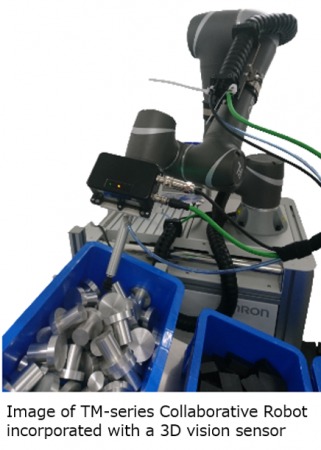
To address this need, OMRON developed a 3D vision sensing technology. This new technology enables high-speed, high-accuracy three-dimensional object recognition and provides a compact and lightweight vision sensor that can be mounted onto robot hands. Whereas measurement by conventional 3D measurement technology using the phase-shifting method requires time since 10 or more images need to be captured, OMRON developed a 3D measurement technology capable of generating a 3D image of a target object in a single shot using a proprietary pattern illumination. In addition, by extending the high-speed 2D search technology it accumulated in the image processing field to 3D, OMRON developed a high-speed object position and orientation recognition algorithm for the 3D recognition technology. These technologies allow for high-speed part recognition for fluid part picking in approximately 0.5 seconds. Furthermore, mounting cameras onto compact robot hands became possible as OMRON’s proprietary pattern illumination reduced the camera size and weight to approximately 500g. The 3D vision sensor’s visual point can be moved in accordance with the part setup, allowing for flexible picking of parts in various positions and orientations.

A robot incorporated with a 3D vision sensor can pick bulk parts in multiple parts containers. It takes approximately 0.5 seconds for it to take the image of a part and recognize its position and orientation.
For more information:
www.omron.com

 Tiếng Việt
 Tiếng Anh
 Tiếng Hàn
 Tiếng Trung