“Design/Manufacturing Closed-Loop” for Cylindrical Gears

“Closed-Loop” is a term used in state-of-the-art bevel gear manufacturing, but has not been widely used, at least not as a term, in the cylindrical gear world. The “Closed-Loop” in manufacturing aims at minimizing manufacturing deviations by using evaluation software to determine the necessary correction values for the adjustment of the production machine. This optimizes the manufacturing process so that the manufactured parts achieve the specified accuracy. In the “Design/Manufacturing Closed-Loop” for cylindrical gears developed by KISSsoft, a feedback of the manufacturing deviations to the desired properties of the design (e.g. Noise Vibration Harshness (NVH) behavior under load) is performed. If the cumulative deviations are too high, the manufacturing must take measures or a reject selection must be made. This analysis can be performed with the help of KISSsoft calculations. First, gears are designed in the design process according to the desired criteria. After manufacturing, the tooth flank geometries of milled or ground gears are measured, for example on a Gleason measuring machine, and fed back into the KISSsoft program. With the measured tooth flanks, important performance criteria in the drive train such as pattern, NVH behavior or service life are recalculated. The simulation results can then be compared with the design results and allow a functional evaluation of manufacturing deviations in the system. With this closed-loop approach, the design can be modified to match a manufacturing process – or the manufacturing process can be tested for suitability to achieve the desired transmission performance at the lowest cost. This way, design, manufacturing and measurement are integrated into one holistic process. For more information: www.kisssoft.com


Bài viết liên quan

Tin mới nhất

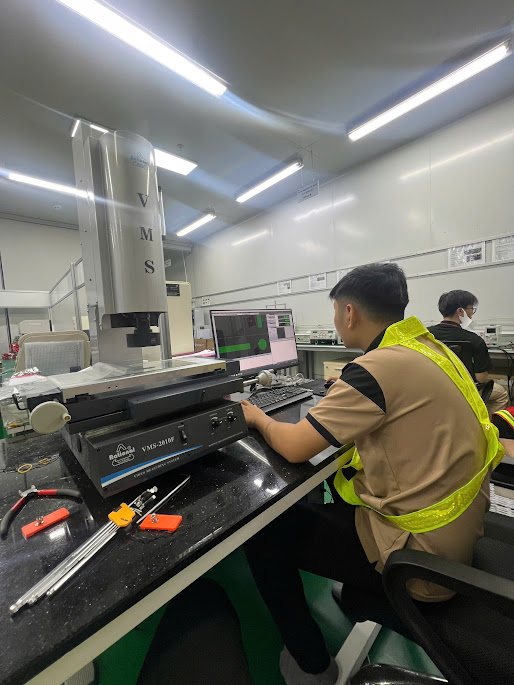
3D Vina Bàn Giao Máy Đo 2D VMM Rational Cho Tập Đoàn TCL Tại VSIP 2 Bình Dương 3D Vina Bàn Giao Máy Đo 2D VMM Rational Cho Tập Đoàn TCL Tại VSIP 2 Bình Dương
Kiểm tra độ tin cậy cho sản phẩm điện tử tại Trung Quốc Kiểm tra độ tin cậy cho sản phẩm điện tử tại Trung Quốc
Thiết bị đo lường điện là gì? Thiết bị đo lường điện là gì?
Kiểm tra pin Lithium-Ion: quy trình, tiêu chuẩn và an toàn Kiểm tra pin Lithium-Ion: quy trình, tiêu chuẩn và an toàn
Kiểm tra sốc cơ học Kiểm tra sốc cơ học
Sự khác biệt giữa thử nghiệm sốc nhiệt và thử nghiệm chu kỳ nhiệt độ là gì? Sự khác biệt giữa thử nghiệm sốc nhiệt và thử nghiệm chu kỳ nhiệt độ là gì?
Buồng thử nghiệm khả năng chịu nhiệt độ nóng lạnh – Buồng sốc nhiệt Buồng thử nghiệm khả năng chịu nhiệt độ nóng lạnh – Buồng sốc nhiệt
Tại sao nên kiểm tra khả năng chống cháy của sản phẩm? Tại sao nên kiểm tra khả năng chống cháy của sản phẩm?
Hiệu chuẩn thiết bị đo lường là gì? Hiệu chuẩn thiết bị đo lường là gì?
Máy đo độ cứng di động: công nghệ tiên tiến trong quá trình kiểm tra công trường Máy đo độ cứng di động: công nghệ tiên tiến trong quá trình kiểm tra công trường
Máy kiểm tra độ cứng: Hiểu rõ về các lựa chọn để đạt được kết quả tốt nhất Máy kiểm tra độ cứng: Hiểu rõ về các lựa chọn để đạt được kết quả tốt nhất
Ứng dụng của tủ thử nghiệm áp suất thấp/mô phỏng độ cao Ứng dụng của tủ thử nghiệm áp suất thấp/mô phỏng độ cao
Một số lỗi thường gặp ở tủ thử nghiệm môi trường Một số lỗi thường gặp ở tủ thử nghiệm môi trường
Tensile Strength là gì? Giới hạn độ bền kéo của vật liệu Tensile Strength là gì? Giới hạn độ bền kéo của vật liệu
Tensile strength là gì? Tổng quan về độ bền kéo vật liệu Tensile strength là gì? Tổng quan về độ bền kéo vật liệu
Giải thích hoạt động của buồng thử nghiệm chống bụi Giải thích hoạt động của buồng thử nghiệm chống bụi
Ứng dụng và tiêu chuẩn thực hiện trên máy kiểm tra độ bền kéo Ứng dụng và tiêu chuẩn thực hiện trên máy kiểm tra độ bền kéo
Phương pháp kiểm tra độ bền kéo đứt vải, giấy, nhựa Phương pháp kiểm tra độ bền kéo đứt vải, giấy, nhựa
Máy kiểm tra vạn năng UTM – Kiểm tra độ bền kéo Máy kiểm tra vạn năng UTM – Kiểm tra độ bền kéo
Buồng nhiệt độ độ ẩm và cấu tạo của nó Buồng nhiệt độ độ ẩm và cấu tạo của nó