Volvo Car USA is rolling out a new program to equip U.S. retailers with automated vehicle-inspection systems that aim to improve customer satisfaction and business efficiencies to further strengthen the Swedish automaker’s reputation for product quality and safety.
High-speed, camera-based systems from Israel-based UVeye utilize artificial-intelligence and machine-learning technologies to check tires, underbody components and vehicle exteriors for defects, missing parts and other safety-related issues.
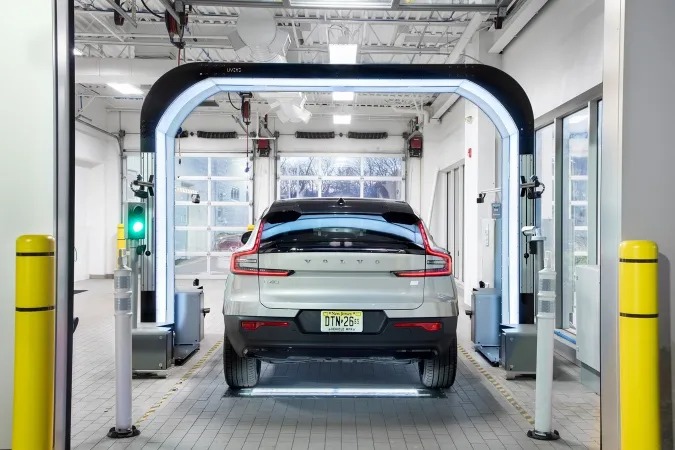
The automated vehicle inspection process takes seconds to complete and is significantly faster than time-consuming manual inspections, according to Rick Bryant, the vice president for sales operations at Volvo Car USA. This helps give retailers the ability to valuate trade-ins quickly, and cost-effectively, as well as check the condition of customer cars coming in for service.
The Volvo Car USA program is being launched at select retailers on the East Coast. The company ultimately hopes a majority of its more than 280 independent retail locations in the U.S. will install the new automated vehicle-inspection systems.
UVeye and Volvo Cars have collaborated since 2019 when the automaker became a strategic investor in the company through the Volvo Cars Tech Fund. Since then, Volvo Cars also has installed UVeye body-inspection scanners on its assembly lines for quality assurance.
“This is a homerun for Volvo Cars and our retailers,” Bryant said. “
UVeye’s automated systems will add a new level of credibility to the inspection process for us, for our retailers and for our customers.”
Volvo retailers can install three basic UVeye inspection systems:
Helios – An underbody scanner that detects a wide range of problems from frame damage to oil leakage and corrosion.
Artemis – A tire system that quickly identifies tire brand, basic specifications, air pressure, tread depth, sidewall damage and even whether a vehicle’s tires are mismatched.
Atlas – A system that provides 360-degree scans of the exterior and detects damage such as dents, scratches and rust on critical components such as bumpers, mirrors, door locks, grilles and windows.
UVeye systems are designed to spot safety issues ranging from damaged tires to defective underbody parts, potentially identifying more serious problems before they occur, or even preventing accidents.
The new service department technology offers three major benefits for Volvo Car retailers and their customers. For starters, it helps service technicians quickly identify problems to expedite maintenance and repair work.
Secondly, it tells Volvo Car owners who cite safety as an important purchase consideration that their vehicles are in good hands and receiving safety inspections using advanced technology to achieve even higher quality.
And finally, these new systems can create digital ‘vehicle health’ reports with photos that can be shared with each customer. These reports allow the dealer to include their customers in the inspection process.
Volvo Cars sees opportunities for ‘all sorts of applications’ for the new technology, including its use for vehicle trade-in appraisals. Car owners, for example, often think their trade-ins are in better condition than they really are.
“An automated system can help resolve problems,” Bryant says.
“It shows the vehicle’s actual condition. The result is that customers will be able to see flaws such as a rusty tailpipe that they didn’t know about. And they’ll also know the retailer is being upfront with them.”
David Oren, UVeye’s chief strategy officer, notes that,
“Volvo Cars and its retailers are clearly interested in capabilities and technology that add up to better service for their customers. Volvo Cars stands out for its commitment to safety and its strong engagement with customers.”
For more information:
www.uveye.com

 Tiếng Việt
 Tiếng Anh
 Tiếng Hàn
 Tiếng Trung