The DAIKEN Industries plant in Pilsen, Czech Republic, produces over two million air conditioning units per year. A lack of manpower and attempts to minimize human errors are reasons why DAIKIN focuses on process automation in their production plans fulfillment, with continuous attention to high product quality.
In one of its assembly lines, there was a specific bottleneck in a mid-assembly quality-check process that required a new approach based on a high-quality 3D vision system – a test of the integrity of heat exchangers. The major motivation to automate the sensitive test and the challenge per se lied in the requirement for high preciseness during the inspection of heat exchangers. Because they are made of thin, fragile metal, human errors in the preceding manual inspection process occurred. The required precision of robot guidance in the planned automation solution was +/- 1 millimeter.
The solution from Photoneo consisted of a tailor-made application based on accurate localization and robot-camera calibration. The heat exchanger, first pressurized with helium, comes to a leak-detection cell on a conveyor belt, where it is positioned randomly.
In the inspection cell, the PhoXi 3D Scanner scans the object from two different positions to increase the reliability of measurement and the robustness of localization. The system detects the position of the heat exchanger and adjusts the predefined trajectory of the sniffing detector very precisely and carefully along a complex and fragile surface of the object in order to inspect its quality and notice potential helium leakage without damaging it. In addition, Photoneo simplified its robot-camera calibration process to such an extent that calibration can be done by a trained end-user operator without on-site presence of Photoneo’s specialists.
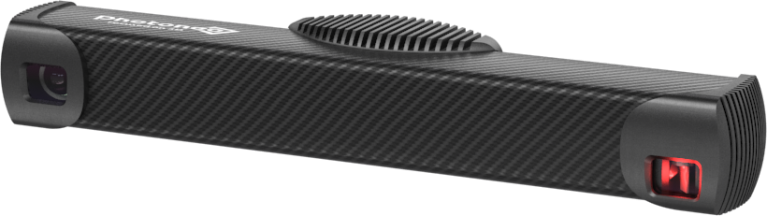
The whole solution is demanding in terms of working with glossy aluminum surfaces, the configuration, precision of the scanner, and localization software. Moreover, the component geometry of the pieces coming on the conveyor belt is often not identical, so a robust logic had to be implemented to reflect this. The robotic manipulation with the detector as a tool had to be very gentle and precise given the formability of the thin metal material of the parts.
Photoneo’s team tackled a very limited workspace of the leak-detection cell in the brownfield deployment. The solution is installed in a production line with a variable just-in-time production plan which means that several types of heat exchangers are subject to a quality check, not just one. The system is extensible, i.e. even after the initial setup for a set of certain heat exchanger types, new ones may be added and probed later on.
There is no programming involved and the change is doable only in configuration by a Photoneo specialist. The addition or alteration of the configuration for a particular type of heat exchanger does not affect the quality of service provided for other existing types.
For more information:
www.photoneo.com

 Tiếng Việt
 Tiếng Anh
 Tiếng Hàn
 Tiếng Trung